

History of Andaman and Nicobar Islands
- Andaman and Nicobar Islands
🏝️ History of Andaman & Nicobar Islands – A Timeless Tale of Culture, Courage & Colonization
The Andaman and Nicobar Islands, nestled in the southeastern Bay of Bengal, are not just a tropical paradise but a land rich in ancient heritage, colonial struggles, and strategic importance. Today a Union Territory of India, these islands—dotted with turquoise waters, lush rainforests, and serene beaches—have a fascinating story to tell.
🧬 Ancient Origins: Where Time Began
Genetic studies suggest that the Andamanese tribes have lived in isolation for over 30,000 years, making them one of the oldest surviving human cultures. While archaeological findings trace evidence back only around 2,200 years, their oral traditions and customs carry the echoes of a forgotten world.
The name “Andaman” is believed to be derived from Hanuman, the Hindu deity, whose ancient Sanskrit name was “Andoman.” This mythological connection reflects the deep cultural roots of the region.
🗺️ The Nicobar Connection
The Nicobar Islands, located further south, also boast a long and storied past. Between 1014 and 1042 AD, the Chola Dynasty used the Nicobars as a strategic naval base and named them Manakkavaram, meaning “open land.” Later, explorer Marco Polo referred to them as “Necuveran,” a Europeanized version of the Tamil name, which gradually evolved into Nicobar during British colonial rule.
⚔️ The Battle of Aberdeen – A Fight for Freedom
In 1859, the historic Battle of Aberdeen occurred between the indigenous Andamanese tribes and British forces. Although outnumbered, the tribes fought fiercely to defend their homeland. Today, a memorial stands at the Rajiv Gandhi Water Sports Complex in Port Blair as a tribute to their bravery and sacrifice.
🛡️ Colonial Rule & Kalapani – The Dark Chapter
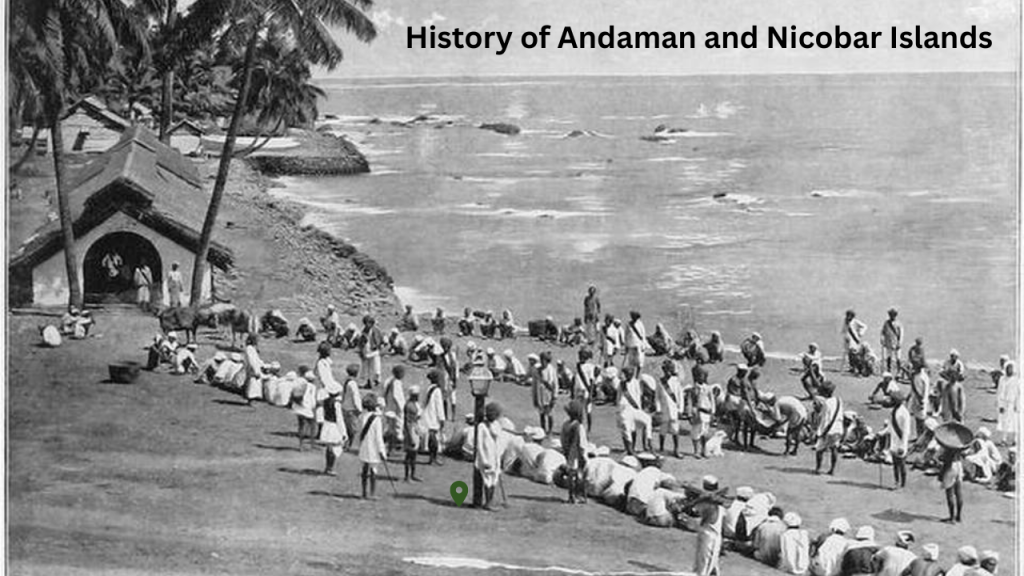
The British established a colony in 1789 at Port Blair but abandoned it by 1796 due to unfavourable conditions. They later reestablished control in the 19th century, and the islands were turned into a notorious penal colony known as Kalapani or the Cellular Jail.
Freedom fighters and revolutionaries who opposed British rule were exiled here under life imprisonment, forced to endure harsh conditions far away from the mainland. The Cellular Jail remains a powerful symbol of India’s struggle for independence and is now a national memorial.
⚔️ Japanese Occupation & Netaji’s Vision
During World War II, the islands were invaded by Japanese forces in 1942, who inflicted severe suffering on the local population. However, it was Netaji Subhas Chandra Bose who hoisted the Indian national flag on the islands and declared them free from British rule—making Andaman the first Indian territory liberated from colonialism, albeit briefly.
The British regained control in 1945 before finally withdrawing in 1947, when India gained independence.
🇮🇳 A New Beginning: Union Territory of India
In 1956, the Andaman and Nicobar Islands were officially designated as a Union Territory of India. Since then, these islands have blossomed into a symbol of India’s natural and historical wealth.
Today, Port Blair stands as the vibrant capital, welcoming thousands of tourists each year. With its crystal-clear waters, tropical charm, and layers of history, the archipelago offers much more than just a beach escape—it tells a story of resilience, resistance, and rebirth.
🔖 Tags:
History of Andaman and Nicobar IslandsAndaman Cellular Jail factsBattle of Aberdeen AndamanChola Empire Nicobar IslandsColonial history of AndamanKalapani freedom fighters Japanese invasion AndamanSubhas Chandra Bose in Andaman
💡Explore the past while walking through paradise – discover Andaman with Andaman Fun Holidays, where every trip comes with a story worth remembering.

Love Where Your're Going
Love Explore Your Life, Travel Where You Want!
Love where you’re going—travel to Andaman and Nicobar Islands for stunning beaches, vibrant marine life, peaceful nature, and unforgettable adventures.
